
Sand Media Filters
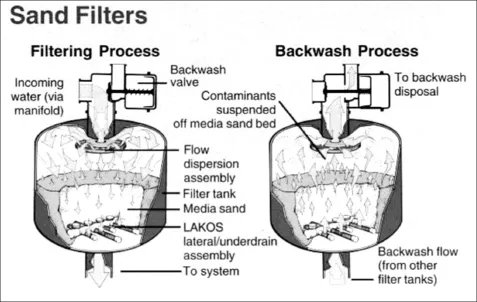
A sand media filter consists of tanks filled with silica sand or crushed granite. Contaminants are filtered from the water as it flows through the filtering media (fig. 11). Multiple tanks of sand media are used to obtain sufficient filtration at the design flow rate of the irrigation system. At least two tanks are required because the filtered water from one tank is used to backflush the other tank. The tanks are usually made of carbon steel or stainless steel, although a composite material is available that greatly reduces the weight of the tank.
Water flowing through the filter is collected at the bottom of the tank by an underdrain system. Types of underdrains include an epoxy-aggregate composite or slotted or perforated screens covered with gravel.
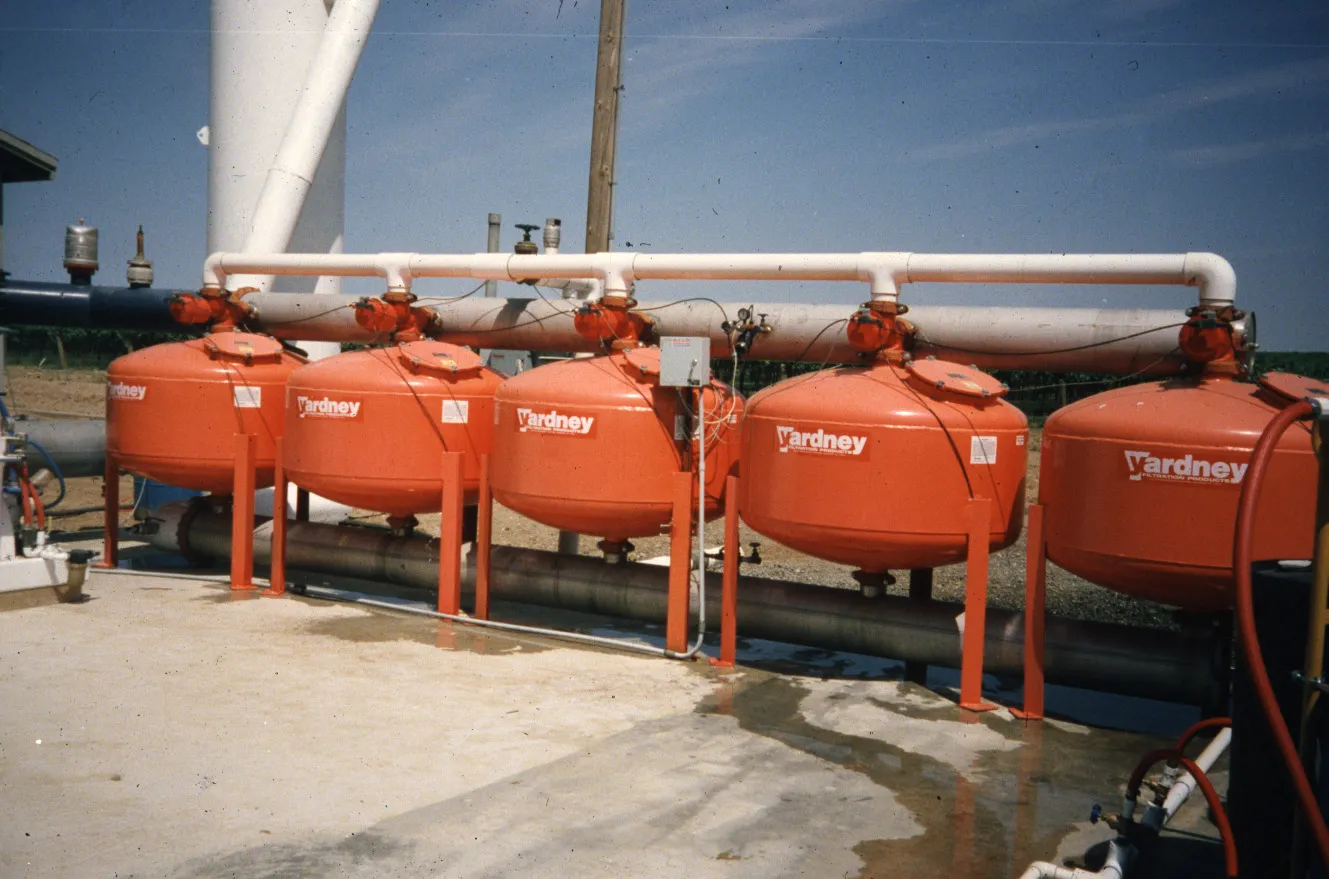
The recommended design filter flow rate depends on the amount of suspended material in the water. For dirty water (100 ppm or more of suspended material), an acceptable filter flow rate is about 15 gallons per minute per square foot of filter area. The recommended rate for “average water” is 20 to 25 gallons per minute; for clean water (less than 10 ppm of suspended solids), the rate is 25 to 30 gallons per minute. An excessive filter flow rate can reduce the filtering ability of a sand media filter by forcing larger particles to pass through.
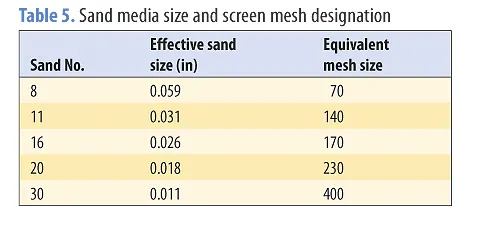
The design pressure drop in a sand filter is 3 to 5 psi. The filter should be backflushed when the pressure drop becomes about 10 psi. Backflushing reverses the flow through one filter at a time and uses the clean water from the other filters to remove the contaminants. The backflushing flow rate should be sufficient to fluidize or suspend the sand media, allowing the contaminant to be carried out by the backflushing water. The recommended backflushing flow rate is 10 to 15 gallons per minute per square foot of filter area for Nos. 30 and 20 sands, and 20 to 25 gallons per minute for Nos. 16 and 11 sands. The actual backflushing flow rate should be determined by visual observation; it should be sufficient to clean the filter but only a very small amount of sand media should be carried out during backflushing.
Periodic chlorination of a sand media filter also may be required. Biological matting can occur in the filter, severely degrading its performance. These mats also may prevent an adequate backflushing flow rate. In addition, organic material may grow in the filter during the off season. Using a chlorine concentration of 10 to 20 ppm for several hours has successfully restored filter performance. The chlorine can be added by injecting it upstream of the filter during an irrigation or it can be added by hand to the filter through the filter access port while the irrigation system is shut down. Always be sure that all water pressure has dissipated prior to opening an access port.