
Light Brown Apple Moth and Targeting Vulnerable Young Larvae
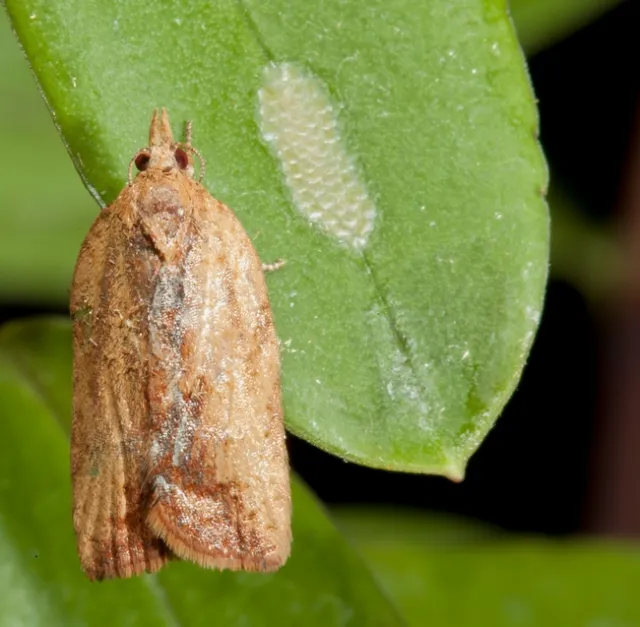
The Light Brown Apple Moth (LBAM) is an important invasive pest for California, and is established in much of California's coastal and some inland areas where nursery products are produced. It is a federally and state regulated pest in many ornamental and fruit crops.
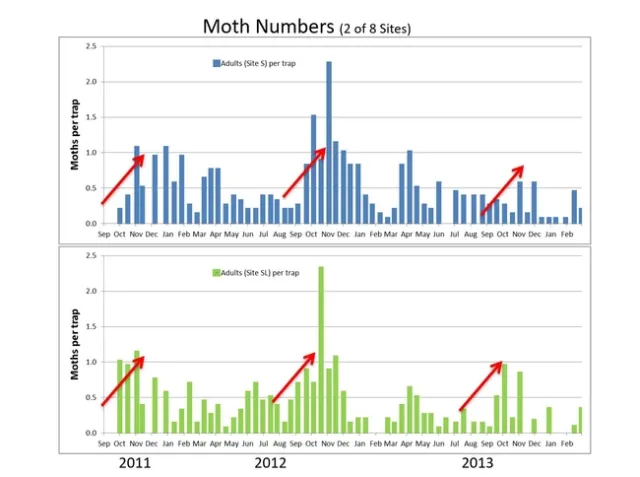
Although the LBAM life cycle (egg to adult) progresses and develops through the entire year, our monitoring around the Monterey Bay Area production areas showed that there were peaks in LBAM flights consistently in the Fall (see red arrows).
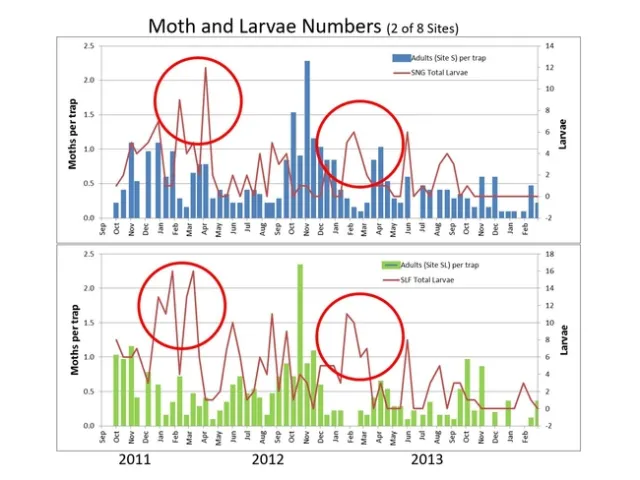
These adults produce a focused generation of young larvae (see red circles), if detected early enough, could be targeted with a softer pesticide such at Bacillus thuringiensis (B.t., e.g. Dipel), which is active mainly on young larvae. B.t. is selective to moth larvae such as LBAM, therefore not interfering with parasitoids of LBAM, and it is relatively inexpensive.
A pesticide application, particularly with a short residual pesticide such as B.t., should be made when young larvae are detected through scouting. However, identifying larvae of LBAM has always been difficult. There are many look-alike leafrollers , especially when they are younger. We produced a LBAM identification guide and training video that helps identify adults, eggs, pupae, and most importantly, the targeted larvae.
LBAM ID Guide and Video at LBAM identification